Author the room
Walk the real space, draw its corners, and mark the thresholds that connect it.
An iPhone 11 becomes a haunted field instrument—when the device cannot actually see the room.
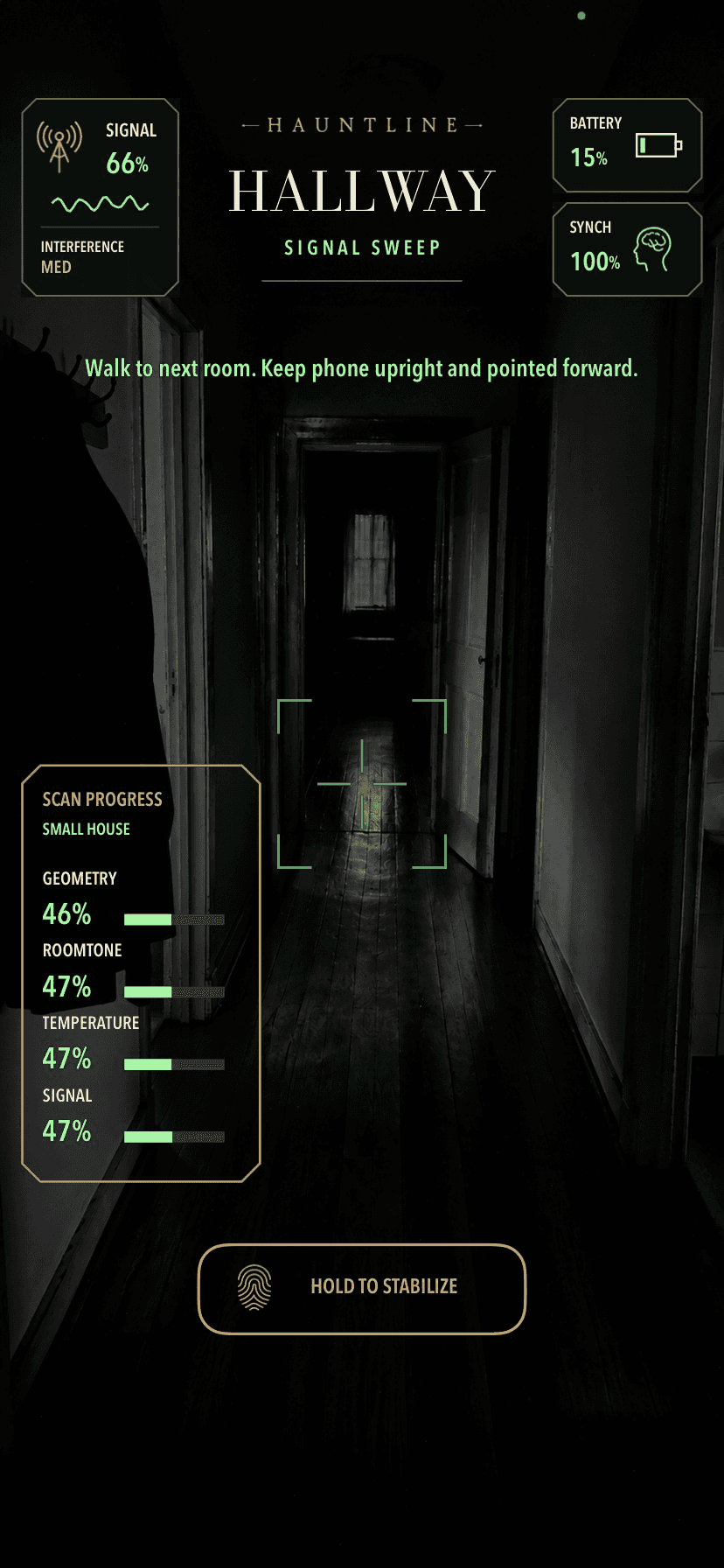
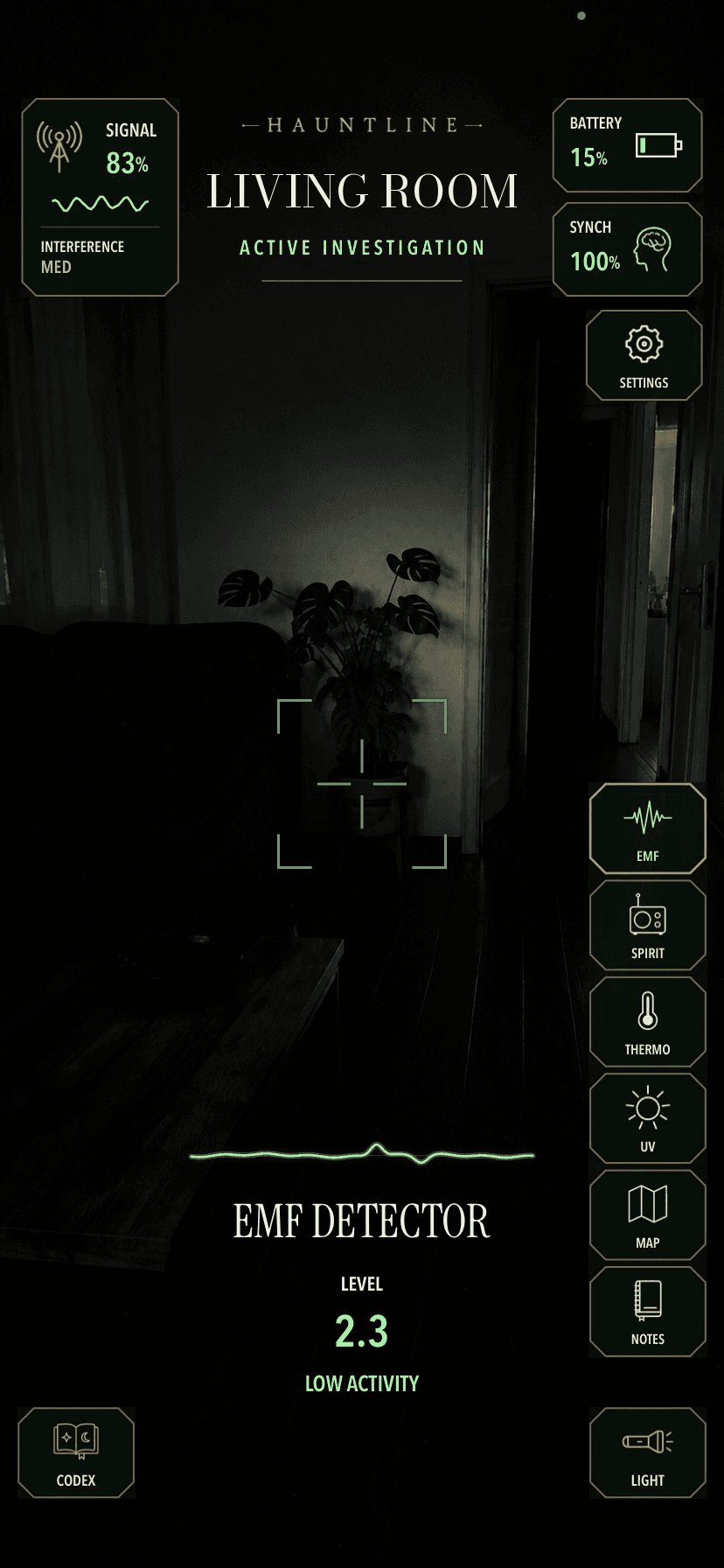

Hauntline started with a constraint: the old iPhone had a camera and microphone, but no LiDAR, no dependable depth and no finished game around it. The answer was to make the device itself part of the fiction. Every limitation became something the player had to read, manage or fear.
“The phone is not a HUD. It is the haunted object.”
Walk the real space, draw its corners, and mark the thresholds that connect it.
Use EMF, Spirit Box, Thermometer and UV to build a picture that is always incomplete.
SYNCH drains, apparitions interrupt, and the phone starts to feel less like a tool.
Manage SYNCH as apparitions and unstable evidence make the phone less reliable.
Designing spatial systems on an older iPhone meant replacing invisible machine certainty with visible player-authored certainty. The player does not enter a perfect digital twin; they negotiate with a fragile model of their own room.
There is no instant room mesh. The player draws room corners, floor thresholds and a front-door anchor by hand.
The scan becomes an action, not a loading screen.Without LiDAR or RoomPlan, the prototype combines player-authored room flags, ARKit and motion tracking to estimate location.
Realign and No Signal make uncertainty visible.Limited performance means controlled apparition timing, restrained compositing and carefully timed feedback instead of spectacle.
Timing becomes the special effect.One floor. Manual scan. Camera-led, sensor-assisted spatial model. Realign, No Signal, drift, mirrored rooms and room-switch failures were not side notes—they shaped the interaction language.
During setup, the lights stay on and the doors stay open. The player scans each room, draws its boundary and traces its thresholds; once the house is mapped, the investigation can continue in darkness.
Hauntline layers a small set of physical inputs into a rising cognitive load. The player is always asking: what did I actually detect, what did the system invent, and how much longer can I stay connected?
During setup, keep the lights on and doors open. Scan each room, draw its boundary, trace the thresholds and mark the front-door anchor. Once the house is mapped, continue the investigation in darkness.
The spatial model can drift, mirror or lose a room. Realign asks for the anchor again; No Signal turns a technical limitation into pressure.
EMF, Spirit Box, Thermometer and UV are available throughout the investigation. Switch between them freely; the flashlight and map remain useful, but interference can make the flashlight unreliable.
Start at 100%. EMF spikes, temperature events, UV scans, Spirit Box responses and sustained apparition focus can drain SYNCH. Regular apparitions unlock at 85% or below, approaching apparitions at 60% or below, the critical state at 10% or below, and forced desynchronization at 0%.
Focusing the camera on an apparition drains 1% of SYNCH every 0.3 seconds. UV apparitions are floor-aligned, may begin just outside the frame, and hold for roughly 2–4 seconds once centered before blinking out.
The notebook keeps the top three temperature highs/lows, top three EMF readings, Spirit Box replies, UV traces and events per room.
Carpenter is the current visible apparition. The proposed roster—Residual, Wraith, Revenant, Chorus, Threshold, Mimic—would shape a future behavior and evidence system.
The prototype asks the player to survive the hunt and match the haunted room, rite and hidden type. The evidence balance and entity behaviours are still being tuned.

The current prototype separates the visible apparition from the hidden type assigned to the case. Carpenter is the appearance; the behaviour-based clues that distinguish entity types are still being tuned.
The image the player sees in the camera: a recognizable presence while the underlying identity system is still being developed.

Rites are not a spell menu. They are the voice-activated layer for temporary edits to attention, noise and access. They give the player just enough agency to keep investigating while the survival loop and balance continue to evolve.
Every signal is temporary, but the notebook is persistent. It turns an anxious walk through the apartment into a trail of decisions the player can revisit before continuing, saving or ending the case.

The map, room memory and SYNCH persist through close and reopen. Continue re-anchors the front door; END CASE or forced desync clears the active run. The current case record stores room geometry, evidence snapshots and room-memory data. Entity identification, rites and banishment are present as prototype systems; their evidence balance and behaviour logic remain in development.
Footprints and handprints were prototyped around haunted and adjacent rooms; without reliable depth, their timing and placement remain under evaluation.
Hauntline is still in development. That is exactly why the process matters: the prototype is a record of how a game can be designed around missing technology, uncertain evidence and the emotional timing of a phone screen.
The question was not how to add ghosts to AR. It was how to make the phone itself feel unreliable.
Scan, trace, listen, measure, focus and speak were tested as small interactions before becoming a larger system.
Drift, mirrored rooms, lost signal, passive room memory and forced desync became design material instead of bugs to conceal.
The prototype is still in development. Its value is the behavior model and the decisions it makes possible—not a claim of completion.
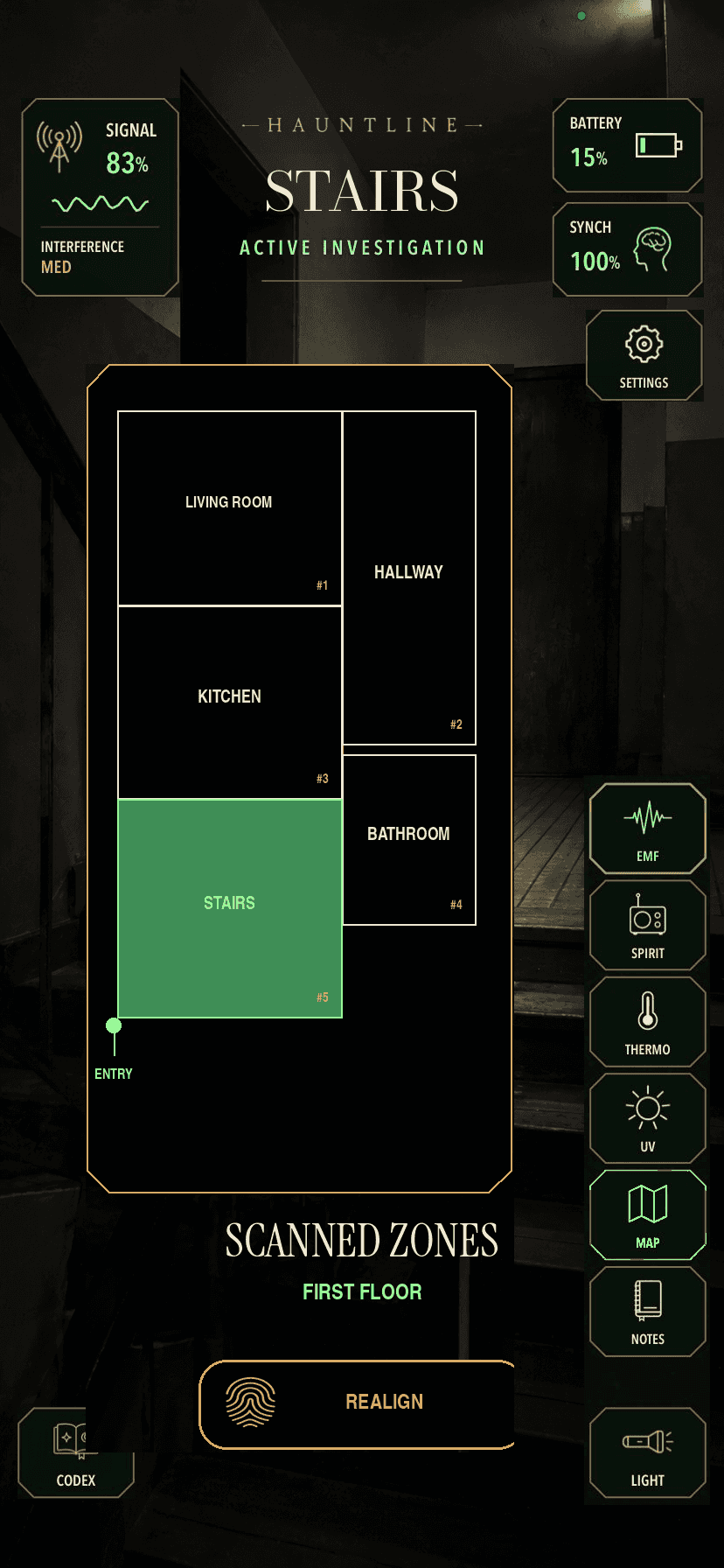
Camera-led, sensor-assisted investigation · one-floor manual scan · Carpenter appearance · voice rites and hunt logic implemented · entity behaviour and evidence balance in development.